Build: ce73c393 (Oct 25, 2026 | Upgraded from VST3 Build dd36b8f4)
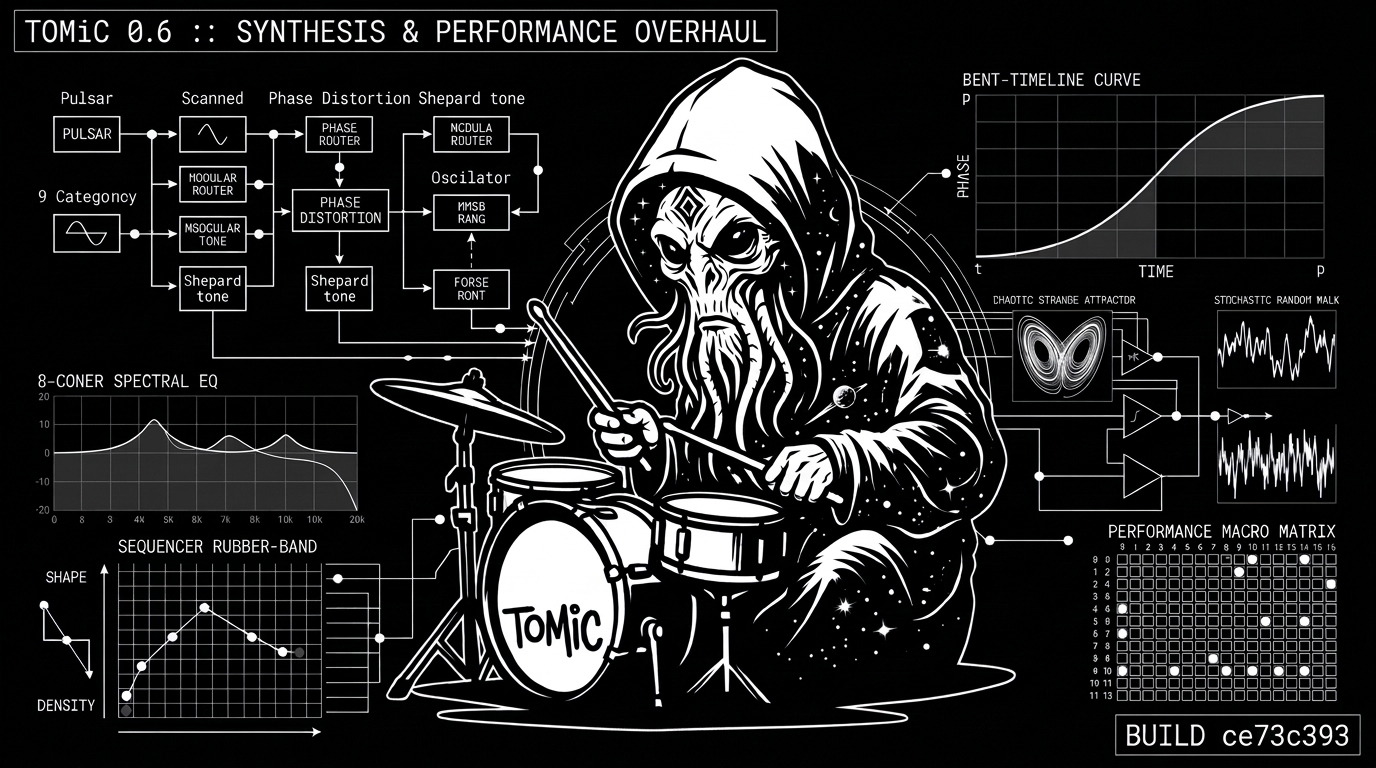
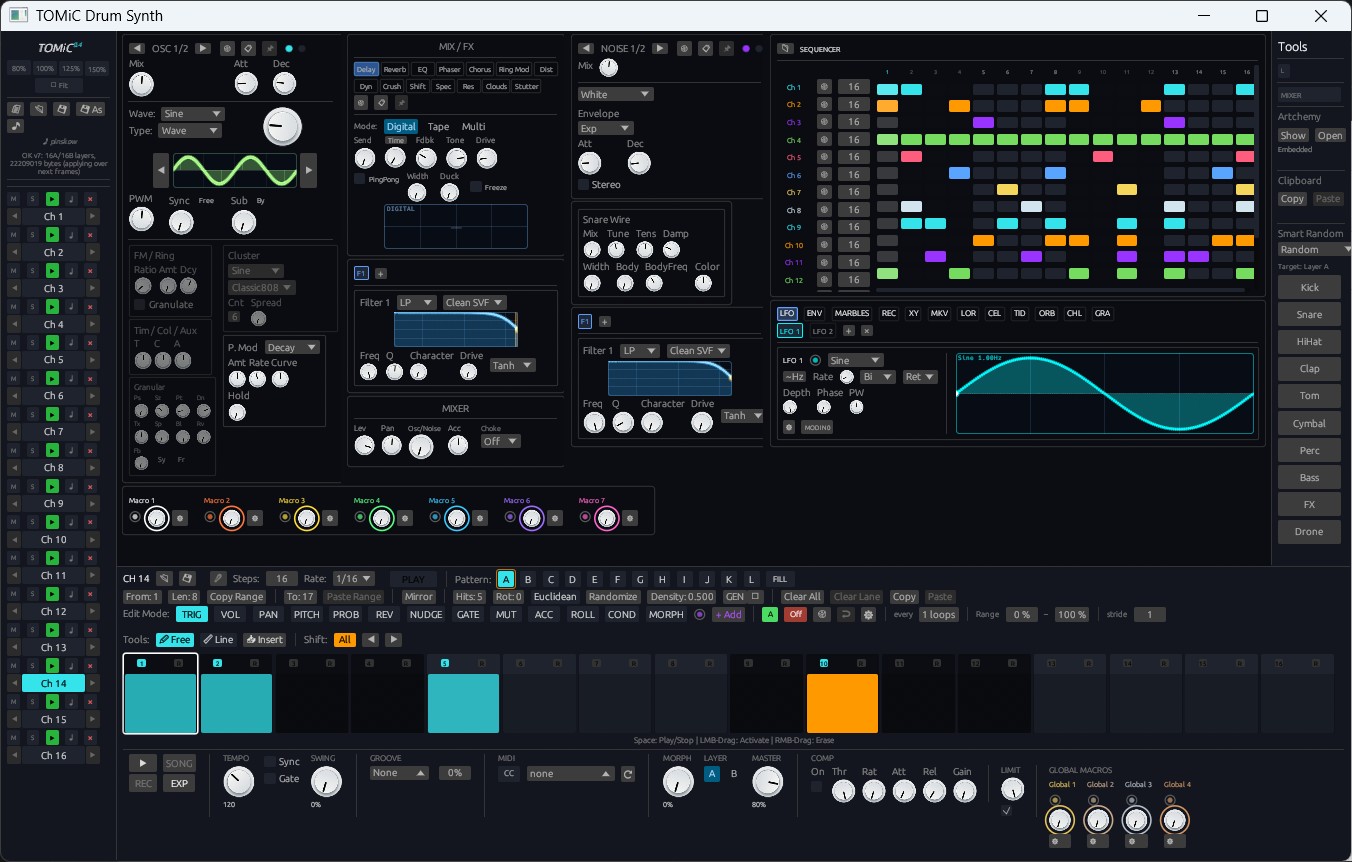
Following hot on the heels of the native VST3 hosting and hardened out-of-process scanner milestone, TOMiC 0.6 has undergone its most expansive sonic and algorithmic evolution to date. Over 25 intensive commits have introduced nine cutting-edge oscillator synthesis families, three new stochastic and chaotic noise engines, bent-timeline Phase Warp sample playback, a zero-latency Cloner acoustic strike engine, a dedicated Performance macro controller with COMMIT, active modulation routing indicator dots, an overhauled full-width Noise Sample mode with inline Cloner and Warp knobs, an exhaustive filter anti-latch stability audit, rubber-band sequencer SHAPE and DENSITY, hit-driven modulation lanes (TRIG / RETRIG), and a fully visual Wave & Noise Source Picker with live DSP curve rendering.
Here is the complete breakdown of everything delivered in Build ce73c393:
🌊 1. Nine New Oscillator Synthesis Algorithms
The internal oscillator engine has been vastly expanded, bringing esoteric physical modeling, mathematical curiosities, and vintage electronic synthesis directly to voice Layer A and Layer B:
- Casio CZ Phase Distortion (PD): Recreates the beloved Japanese synthesizer architecture with seven distinct transfer waveforms including resonant sawtooth, trapezoid, pulse, double sine, and resonant triangle. The AUX control smoothly sweeps resonance shaping without analog filter overhead.
- Moorer Discrete Summation Formulae (DSF): Generates pristine, band-limited harmonic series using analytical closed-form summation. The AUX parameter governs spectral roll-off and harmonic density with zero anti-aliasing artifacts.
- Roads Pulsar Train Synthesis: Generates acoustic particle streams inspired by Curtis Roads’ granular theories, featuring burst masking and stochastic dispersion. TIMBRE and COLOR adjust pulsar duration and formant resonance.
- Scanned Synthesis (32-Mass Struck String Model): A physical simulation of a 32-point coupled mass-spring loop computed at an internal 2 kHz physics rate inside shared delay memory. Hitting a note strikes the virtual string, sending realistic vibrational deformations that evolve and damp dynamically.
- Wave Terrain Synthesis: An orbital trajectory moves across a 3D mathematical landscape surface, translating coordinates into rich, evolving wavetable-like harmonic sweeps.
- Sequency-Ordered Walsh Functions: Generates rich stepped digital timbres based on Hadamard transform matrices, providing an orthogonal alternative to classic sinusoidal Fourier harmonics.
- Lamé Superellipse: Geometric waveform generation modeled after the Lamé curve equation ($|x/a|^r + |y/b|^r = 1$), featuring continuous exponent morphing and rotational phase shifting.
- Wave Warp: Six specialized non-linear phase-warp transfer functions for aggressive asymmetric wave deformation.
- Shepard / Risset Auditory Illusion: An endless, seamlessly looped frequency stack that appears to rise or fall indefinitely without any audible clicks or wrapping discontinuities.
All oscillator algorithms feature stateless DSP curves that render live preview thumbnails inside the waveform visualizer and the new Source Picker.
🌪️ 2. Three Generative Noise Engines: Stochastic, Bytebeat & Chaos
Noise in TOMiC is no longer just white, pink, or metallic chatter — it is an active sonic ecosystem:
- GENDYN Dynamic Stochastic Synthesis (Stochastic): Inspired by Iannis Xenakis’ groundbreaking dynamic stochastic algorithms. A cycle of 3 to 16 breakpoints undergoes second-order random walks with elastic mirror boundaries. Features four selectable probability step distributions (Uniform, Cauchy, Logistic, and Arcsine), producing anything from living organic buzz to menacing acoustic grit.
- Clocked Algorithmic Bytebeat: An integer sample counter cycles through eight bitwise mathematical equations (
t & (t >> 8)...) with dual user bit-shift controllers (A/B). Generates vintage 8-bit rhythmic patterns and computational digital textures that restart phase-coherently on every hit. - Nonlinear Dynamical Systems (Chaos): Implements Logistic maps, Crackle noise, Hénon attractors, and audio-rate cross-coupled Phase Modulation (CrossFm). A single knob smoothly morphs from a clean periodic tone through period-doubling bifurcations straight into turbulent deterministic chaos. In Stereo mode, an infinitesimal initial-condition offset ensures stereo channels remain phase-locked while periodic and bloom into ultra-wide decorrelation once chaos is engaged.
- Full Modulation & Randomizer Integration: All 9 new parameters across both noise layers are mapped as block-rate LFO modulation targets, integrated into the A/B morph engine, channel clipboard, and smart randomizer archetypes ("Perc Glitch").
🌀 3. Phase Warp: Bent-Timeline Sample Playback
Sample playback across both noise layers can now bend time along non-linear curves ($t \to p$) without altering total hit duration:
- Four Mathematical Warp Modes:
- Mirror: Folds the sample timeline back and forth, allowing shorter loops to oscillate seamlessly.
- Shape: Accelerates or decelerates sample playback along exponential and logarithmic curves.
- Split & Swing: Introduces an asymmetrical speed breakpoint to bounce sample timing.
- 32-Point Drawable Curve Editor: Draw freeform time trajectories in either POS (playhead position) or PITCH (playback speed from -4x to +4x) modes with instant bi-directional conversion.
- Click-Free Transitions: Features per-sample knob smoothing and automated de-clicking across loop seams, window edges, and reverse playback boundaries.
- Floating Curve Panel: Includes built-in curve presets and exposes 10 dedicated block-rate LFO modulation targets.
🧬 4. Cloner: Zero-Latency Acoustic Strike Humanization
To eliminate static sample repetition ("machine gun effect"), the new Cloner engine ensures that every trigger produces a uniquely sculpted acoustic strike:
- 8-Band Log-Spaced Peaking Filter Array: Spanning 120 Hz to 10 kHz, center frequencies ($\pm 0.15$ octaves) and gains ($\pm 12$ dB) are independently randomized on every trigger with zero processing latency and zero transient smearing.
- Variation: Determines how far each individual strike deviates from the baseline timbre.
- Tilt: Global tilt balance between dark and bright spectral resonances ($\pm 9$ dB).
- Damp: A dynamic spectral damping envelope pulling high-frequency energy down as the drum hit rings out (up to 120 dB/s), replicating physical head damping.
- Ergonomic Controls: Lives directly on the Warp row with its own dedicated toggle; turning it on immediately reveals its Variation, Tilt, and Damp knobs level with Warp controls without hiding behind context menus.
🎛️ 5. Global Performance Page (DEPTH, FLIP, COMMIT)
Live jamming and kit-wide manipulation are now anchored in a dedicated Performance Page, accessible by clicking the transport bar's MASTER header:
- Kit-Wide Macro Offsets: Control global Pitch (semitones), Decay (x4 to ÷4), Cutoff ($\pm 4$ octaves), Resonance, Distortion, and Mod Amp (-100% mutes all LFO/ModEnv modulation; +100% doubles depth).
- Global DEPTH & Inversion: The master Depth knob scales all performance offsets simultaneously (-100% to +100%). Negative values smoothly flip/invert all parameter trajectories.
- Per-Channel ENABLE & FLIP Bitmasks: Select which channels respond to performance offsets and which channels have their offsets inverted.
- COMMIT (Bake into Kit): Pressing COMMIT permanently bakes the current performance offsets directly into both layers of all active channels and resets the performance knobs to zero.
- Live Status: The MASTER header glows cyan whenever active performance offsets are applied.
💡 6. Active Modulation Indicator Dots & Tidy Layouts
Understanding modulation routing at a glance is now instantaneous:
- Modulator Activity Dots: Group tabs (LFO, ENV, etc.) and slot sub-tabs (LFO 1, LFO 2...) now display a glowing colored dot whenever they are actively routing to a destination (target assigned, depth $\ne 0$, slot enabled).
- Unused Group Dimming: Inactive modulator tabs are cleanly dimmed, eliminating visual clutter. Hovering reveals a tooltip showing the exact number of active destinations.
- Overhauled Noise Sample Layout: Sample playback mode has been re-architected for maximum ergonomics:
- The sample waveform display now spans the full width of the block, providing high-resolution visualization of transients and slices.
- When no sample is loaded, the empty "Drop a WAV" placeholder is cleanly centered between arrows matching the active waveform margins.
- Type and Envelope selectors sit directly beside Load/Create and Round-Robin (RR) controls.
- Pitch, Start, and Length share a clean row with Round-Robin mode and the Sample Manager button.
- Warp and Clone sit side-by-side with vertical 25pt knob columns that keep labels like "Damp" on a single clean line without awkward wrapping.
🛡️ 7. Deep Stability Session & Zero-Delay Feedback Anti-Latch
A rigorous acoustic sweep test suite (tests/stability_sweep_test.rs) evaluated every single variant of every sound-generating enum across the entire engine:
- ZDF Filter Anti-Latch Guard: In zero-delay feedback (ZDF) analog filter models, extreme non-linear drive near the Nyquist frequency previously had the potential to latch into constant DC or endless self-oscillation (such as
ThreeOhThreeat extreme resonance above 15 kHz).AdvancedFilternow clamps feedback parameter $g$ to measured safe ceilings (dsp::filter_stability), completely immune to latch-up while remaining bit-identical below the threshold. - Ladder Drive Scaling Fix: On the
LittleFattyandGrandadtransistor ladder models, in-loop drive previously over-multiplied resonance factor $k$. Drive slope scaling has been corrected, preventing unwanted self-oscillation at mid-resonance settings. - ChildGenius Overdrive Polish: Internal shaper loop in the multi-band filter now uses a clean 75/25 blend, preventing clipping lockup in Wavefold modes.
- Braids Grain & VowelFof Calibration: The Braids Grain oscillator now fires its very first grain immediately on sample 0 (eliminating a former 27 ms latency gap). Braids VowelFof excitation harmonics have been normalized, providing a crucial +34 dB gain correction to standard audible levels.
⚡ 8. Sequencer SHAPE (Rubber-Band Timing) & DENSITY
The pattern editor introduces flexible mathematical timing and density modifiers per channel:
- Rubber-Band SHAPE: Accessible by clicking any channel’s "CH n" label in the pattern editor. Bends step timing across groups: positive values accelerate through the group, negative values decelerate, while strictly preserving bar length and downbeats. Modulation lanes, swing, and groove remain locked to their musical grid coordinates.
- Probabilistic DENSITY: Negative values selectively thin out written triggers; positive values inject ghost hits into empty steps based on the channel's probability distribution.
🔗 9. Hit-Driven Modulation Lanes (TRIG / RETRIG) & Trigger Links
Modulation sequences are no longer constrained to rigid clock ticks:
- Hit-Driven Lane Modes (TRIG / RETRIG): Modulation lanes (Cutoff, Decay, Pitch, Slice, etc.) can now advance per played hit instead of fixed 16th-note clock!
- Trig: Advances one step each time a drum hit actually fires (after conditions and probability).
- Retrig: Advances on played hits, resetting to step 0 whenever the channel's primary trigger loop wraps. Right-click the lane link button to toggle; the link icon turns orange when hit-driven.
- Trigger Link (Channel Striking): The musical inverse of choking. Hitting one channel can now automatically strike another channel simultaneously (e.g., Kick triggers Sub Bass; Snare triggers Noise Clank). Supports multi-channel daisy chains ($1 \to 2 \to 3$) with recursive loop protection. Configured directly in the Choke dropdown under "Also triggers".
🎨 10. Visual Wave & Noise Source Picker
Selecting oscillators and noise generators is now an inspiring visual experience:
- Categorized Sidebar: Sound engines are organized by character rather than internal code structure: Analog / VA, FM & Ring, Wavetable, Vocal, Physical, Drums, Phase Shaping, and Chaos & Stochastic, alongside All, Favorites, and Recent.
- Live DSP-Drawn Thumbnails: Every tile renders a real-time vector curve preview generated directly by the underlying mathematical equations.
- Instant Keyword Search: Search by name, descriptive tags, or acoustic family ("kick", "bell", "grit").
- Parameter Guide: An information bar clearly explains the assigned functions of TIMBRE, COLOR, and AUX for every model.
- Flexible Sizing: Supports both a Large preview panel and a Compact drop-down mode, saved across sessions.
🚀 11. Additional Engine Polish, Master MAXIMIZE & Presets
- Master MAXIMIZE & Output Clipping:
- MAXIMIZE (0–100%): Stereo-linked upward compression lifting quiet tails and subtle reverb decays by up to +30 dB before the master limiter.
- Output Clip Modes: Select between No Clipping, Soft (tanh), Hard, and Wavefold clipping directly from the transport bar's LIMIT menu.
- Four New Distortion Modes: Added Square, Phase (signal-modulated micro-delay), Dropout (zero-crossing waveset skipping), and MiniGlitch (Brownian feedback drift) across channel inserts, pre-filter drive, and the master bus.
- Delay / Reverb S.RATE & GLITCH: Decimate internal effect clocks down to 1/32 for crunchy vintage digital echoes, pitch-bending delays, and shimmering lo-fi reverbs.
- Mono-Compatible Stereo Widener: Overhauled using a complementary comb filter ($+S$ to Left, $-S$ to Right) that completely vanishes in mono ($L+R$), keeping bass tight and centered.
- Modular FX Presets: Factory preset banks (10–15 presets per module) and user presets saved as
.tomic-fxfiles in Documents. - Smart Channel Naming: New Songs and randomized kits now intelligently name channels after their drum archetype (Kick, Snare, HiHat, Perc...) rather than generic numbers.
Commit Log for Build ce73c393
ce73c393— Noise Sample mode: fix staggered Warp/Clone labels and off-centre drop boxa2433bba— Noise Sample mode: Clone works like Warp; centre the empty-waveform box4dbe4af5— Noise Sample mode: tidy layout — waveform full width, controls grouped under it531e0504— Stability session: enum sweep, filter latch-up ceiling, Braids levelsea398976— Modulator tabs: mark the ones that actually modulate somethingf62cf664— Nine new oscillator algorithms: PD, DSF, Pulsar, Scanned, Terrain, Walsh, Superellipse, Wave Warp, Shepard35877f6f— Three new noise types: Stochastic, Bytebeat, Chaosea7e1a1d— Knob tooltips: fixed width, tidy lines; right-click modulation menu5b2200e2— Mono-compatible stereo widenere876b3d9— FX presets for every module + FX tail/perf fixesf2564ba3— Cloner: every sample hit a slightly different strike6b7fd8c1— Performance page: global offsets for every channel, DEPTH, FLIP, COMMITeaa22ad5— Delay/Reverb S.RATE and delay GLITCH (channels + master)98152ab4— Master MAXIMIZE and final clipping mode09778f72— Distortion: Square, Phase, Dropout and MiniGlitch algorithmsefa8e5c3— Per-hit VARIATION per channel (+ which params it may touch)59373f62— LFO reset modes: Sample & Hold and Soft Reseta30933a6— Trigger link: a channel's hits can also strike another channelf08d6d6b— Lanes can advance on hits: TRIG / RETRIG lane modes279fff66— Sequencer SHAPE (rubber-band timing) + DENSITY per channel127ec7b7— Source picker: fix popup stretching to the window bottom; large default07ebf9fd— Source picker: compact by default, opens on the current category61970247— Name startup/New Song channels after their archetypes (Kick, Snare, ...)ce90953e— Wave/Noise source picker: categories, curve previews, search, favorites072aa7a6— Phase Warp: Battalion-style bent-timeline sample playback + drawable curve
TOMiC 0.6 Build ce73c393 represents a quantum leap in drum sound design, expressive sequencing, stability, and performance control. Download the latest build from the TOMiC product page and explore the frontier of percussion synthesis!