Build: e9c1034c | September 26 – October 12, 2026
Two weeks ago Omni learned to play live sets. Since then the work has gone deep into the instrument itself. Almost every built-in effect, every modulator and every MIDI effect has been rewritten from the ground up, with the same goals throughout:
- What you see is what you hear. Every curve, envelope, note and response drawn in the UI is computed by the same code the audio engine runs. No more approximations that drift from the actual sound.
- Bounce equals playback. Randomness, LFOs, chaotic systems and note generators are pure functions of song position and seed. Seeking, looping, freezing and exporting produce exactly what you heard while playing.
- Old projects sound the same. Each rebuilt device keeps its original parameter layout and upgrades older presets to settings that reproduce the old sound or notes, guarded by reference tests against the previous code.
🎛️ Sixteen MIDI Effects Rebuilt
Note Processing
- Velocity: a 74-parameter shaping stage with a PASS / CLIP / GATE input window, SCALE, OFFSET, FIXED, DRAW (8 nodes) and DYN (threshold, ratio, knee, makeup) curve modes, an output range and an invert switch. Groove tracks put accents on the song grid, key tracking and chord-aware top/bass rules, and a Human section with seeded random and drift. A histogram fit can match the curve to the velocities you actually play. 32 factory presets.
- Note Length: FIXED (1/64 to 4/1, with triplets and dotted values, or milliseconds), STRETCH, CLAMP, LEGATO mono and poly, RELEASE and GRID modes. Length can follow gate lanes on the song grid, velocity and key, with humanize and a shaping curve that is the same one the panel draws. 40 factory presets.
- Scale Quantize: a library of 92 scales in 11 families, including the modes of the major, melodic and harmonic minor and harmonic major. Key detection and a tonic progression track follow the song. Snap, White key and Degree mapping, plus tunings from Pythagorean and Werckmeister to Rast and Bayati and your own cents values. 50 factory presets.
- Chord: a Fixed mode with 51 shapes in families, and a Scale mode that builds chords on the scale degrees, from dyads to tredecimals. Voicing covers omit, inversions, drop 2 and 3, open voicing and spread, with voice leading that moves each note the least distance. Strum runs in seconds or beats with a curve and an accent on the top note. Chord names are recognised from the keys you hold.
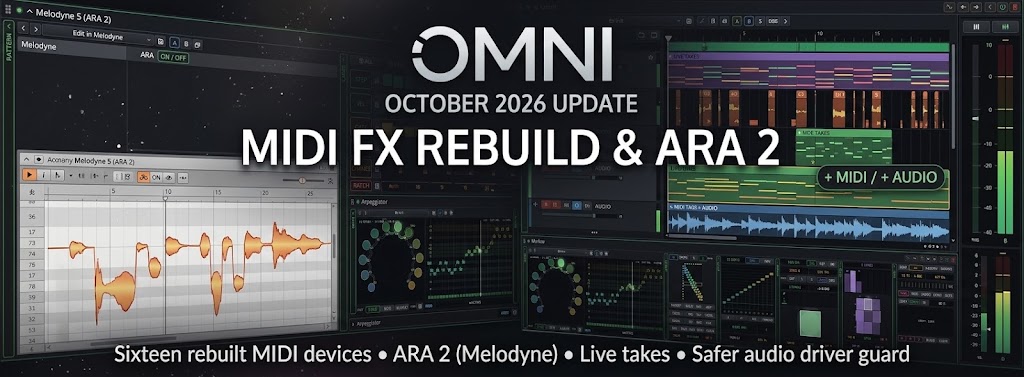
- Arpeggiator: 18 note orders as pure functions, octave modes Up, Down, UpDown and Interleave, latch (Off, Hold, Add), and six polymetric lanes of 16 steps for pitch, velocity, gate, chance and ratchets. Plan steps can tie, skip or rest, and legato can run over 100 %.
- Note Echo: repeats in note values (straight, triplet or dotted) or milliseconds, with Ratio, Swing, Quantize to the song grid, a Feedback envelope, Floor, Echo, Repeat and Tail modes, and a Freeze. Echoes keep playing through loop wrap-arounds and while the transport is stopped. 42 factory presets.
- Random: a chance system on a 16-step lane, where each decision is a function of seed and position. Textures are White, Even (a golden-ratio sequence with no clumps or gaps) or Cluster, pitch can follow the scale, and a Turing-machine style Mutate keeps decisions alive across loops. Timing moves notes later or earlier while keeping their length. 42 factory presets.
Generators
These devices create notes from scratch. Each one is built on a pure function of the song, so a pattern can be seeked or bounced exactly.
- Marbles: three voices on the Marbles modulator core. The rhythm section has 7 models, Spread and Bias shape the pitch distribution, and Déjà Vu repeats loops in the real Mutable Instruments manner.
- Markov: three chains on a shared tick grid, for pitch (2 to 16 states, scale degrees or a held chord), rhythm (1 to 8 states with NOTE, REST and TIE) and dynamics. A 16×16 matrix is edited with live heat maps and statistics, and Learn builds the chains from the keys you play. 43 factory presets.
- L-System: a grammar rewritten over generations and read by a turtle, which turns it into melody. The alphabet, rules and axiom are editable, and the Garden panel draws the plant as it grows and plays. 42 factory presets in 7 families.
- Cellular: a cellular automaton used as a sequencer, in 1D (Wolfram rules 0 to 255) or 2D (Life-like and Generations). The keyboard places seeds, the readout window moves across the field, and each cell becomes a note in the scale. 42 factory presets.
- Thue-Morse: a sequencer driven by automatic sequences (Thue-Morse, Rudin-Shapiro, paperfolding, period doubling, ruler, Fibonacci word, Baum-Sweet and more), each term computed directly from its index. Four voices run as canons, with chance and velocity contours.
- Recamán: the spiral walk that steps back when the value is free and forward when it is not, plus its relatives (cyclic and prime-jump variants). The sequence is checked against OEIS A005132, and the Arcs panel draws every jump as a loop. 42 factory presets.
- Sequence: 16 classic integer sequences in 5 families (Collatz, recurrences such as Fibonacci and Padovan, number theory, self-similar and uniform), every one checked against OEIS. The tables for primes, divisor counts and the digits of π, e and √2 are precomputed, so the audio thread never builds them. 42 factory presets.
- Shepard: Shepard and Risset illusions, where a melody climbs or falls forever. Each event plays a stack of layers one octave apart, with an envelope that fades out at the edges, and a Risset rhythm that accelerates or decelerates without end. 42 factory presets.
- Walks: random walks across musical spaces. A walker moves up a scale or through a chord ladder with Drunk, Gauss, Lévy (a heavy-tailed jump) or Step laws, and a Tonnetz mode wanders through the 24 triads. Wind, Gravity and Edge forces are set per walker, and four voices can run as FREE, FOLLOW or MIRROR. 42 factory presets.
Modulation of Generators
Every generator's readouts are now real controls: right-click for Add Modulation, drag a modulator cable onto them, or MIDI Learn them. Whole-number settings such as Low, High, Octave, Transpose, voice Slow and Delay, and the Shepard and Walks parameters change in whole steps as they are modulated. Settings that rebuild a tape, grammar or field stay out of modulation, and a test confirms that modulating every parameter never allocates on the audio thread.
🎚️ Sixteen Effects Rebuilt: Premium DSP with Live Telemetry
Each effect below was split from a single file into a proper module, gained a preset browser with A/B comparison and factory presets, and got a live Solaris panel fed by lock-free telemetry from the audio thread. Along the way, dozens of long-standing bugs were fixed (zipper noise on automation, NaN poisoning, allocations on the audio thread, UI curves that didn't match the DSP).
Mixing & Dynamics
- EQ (16 bands): analog-matched filter design without cramping near Nyquist, 64-bit processing, 8 shapes including a new Tilt Shelf, slopes from 6 to 96 dB/oct, per-band Stereo/Mid/Side/Left/Right, band solo, Auto Gain and a Linear Phase mode (partitioned FFT convolution, latency reported to PDC). 21 factory presets in the new
.eqomniformat. - Compressor: 6 characters (Clean, VCA, Glue, Opto, FET, Vari-Mu) as complete topology/ballistics/colour sets. Opto and FET are true feedback designs solved without the classic one-sample delay, stable at any ratio. Ratio up to ∞:1, Range, Hold, lookahead up to 20 ms, Peak↔RMS blend, sidechain HP/LP with key listen, Mid/Side modes and ADAA Character saturation. 25 factory presets.
- Limiter: 6 styles (Transparent, Modern, Punch, Vintage, Bus Glue, Safe), per-channel true-peak detection with 4× oversampling, adjustable stereo link, adaptive program-dependent release, TPDF dither and a running "overs" counter. The ceiling is never exceeded in any style (tested).
- Multiband: 1 to 6 bands with Linkwitz-Riley crossovers at 12/24/48 dB/oct whose sum is flat to 0.02 dB, plus a Linear Phase split. Every band has an upper and a lower threshold (downward and upward compression, expansion, gating), its own stereo mode and external key. Switching band count or phase mode is click-free. The old version's output gate that silenced everything below −60 dBFS and the comb-filtering Dry/Wet are gone. 23 factory presets.
- Noise Gate: hysteresis, Gate and Duck modes, three envelope styles (Classic, Smooth, Adaptive) and a key detector that no longer chatters on bass. Lookahead up to 20 ms, key filters with listen, 22 presets.
- Transient Shaper: a new level-independent PUNCH detector working with differential envelopes in dB, a true analytic envelope (instead of |x|, which used to modulate bass), a Focus band, Mid/Side processing, lookahead and an ADAA clipper. A live "hit lens" shows the shaped attack against a ghost of previous hits. The original algorithm is kept bit-exact as the CLASSIC style.
Space & Time
- Reverb: a 16-line feedback delay network with accurate RT60 in three bands, 7 algorithms (Hall, Room, Chamber, Plate, Cathedral, Ambience, Bloom), in-loop shimmer, tempo-synced pre-delay, ducking, Freeze and zero CPU once the tail has decayed. The panel shows a real echogram and an editable RT60(f) curve.
- Convolution Reverb: a custom zero-latency convolver with non-uniform partitions and spread-out spectral work (4 to 17× less CPU for 1 to 12 s impulses, no CPU spikes), true-stereo 4-channel IRs, and non-destructive IR editing (Stretch, Decay, Damping, Early/Late, Reverse, Start/Length, Fade). Ships with 18 synthesized factory IRs. Impulses are now resampled to the project rate (previously a 44.1 kHz IR played at the wrong pitch in a 48 kHz project).
- Delay: 5 engines (Digital, Analog BBD with a true 2:1 compander, Tape with wow/flutter, Multi-Tap, LCR), tempo sync, Stereo/Ping-Pong/Cross routing, cross-fade or tape-style glide when changing time (no more clicks), feedback up to 110 % with a safe ceiling, ducking and Freeze. The "echo field" display predicts every repeat and lets you drag time, offset and feedback directly.
- Chorus: a real 4-voice ensemble with individually offset delay centres, BBD Vintage colour, tempo sync, Width and a string-machine Ensemble LFO.
Colour & Movement
- Saturator: 10 models, including Magnetic, a Jiles-Atherton tape hysteresis model with memory. ADAA combined with up to 8× oversampling (aliasing down to −75 dB on hard clipping at +24 dB), Bias for even harmonics, emphasis/de-emphasis, static Auto Gain and a time-aligned dry path. Live harmonic spectrum and THD readout.
- Filter: 12 models including a nonlinear Moog ladder and a new Vowel formant filter, a continuous Morph through LP→BP→HP→Notch, tempo-synced LFO, envelope follower with sidechain, and click-free model switching.
- Phaser: 5 models (Classic, Vintage JFET/OTA, Vibe with lamp and photocell inertia, Sharp, and an endless Barberpole sweep), 2 to 24 poles and zero-delay feedback, so notches and resonances sit exactly where they would in the analog original. Bass Keep, envelope follower and a phase-plane display.
- Modal Resonator: 32 modes per voice on stable SIMD filters, MIDI-playable, with morphing between models without cutting the ring-out.
- Granular Clouds: an 8-second stereo buffer with anti-aliased transposition, exact grain placement around the moving write head (no clicks), 64 grains, Free/Sync/Onset clocks, Scan, Spray, scale-quantized Detune and a feedback loop with diffuser and plate. The cloud field shows each grain as a glowing particle.
- Sequenced FX: a sample-accurate step engine with per-step chance, ratchets, ties and parameter lanes, polymetric rows, new glitch units (Repeat, Reverse, Tape Stop/Start, Scratch, Crush, Volume), latency compensation, and 15 factory patterns. It also now works correctly in freeze and Live Set renders.
🌀 Modulation Reborn: Control-Rate Curves and Deterministic Sources
Smooth modulation everywhere
Previously the modulation rack applied one value per audio buffer, so fast LFOs and short envelopes reached their targets as staircases. Now every modulator produces a point every 32 samples, independent of buffer size, and effects, built-in synths, volume/pan and the sampler follow the curve inside the block. Built-in synths are even split at parameter events. Modulation of Hz, ms and Q ranges is now geometric, so the amount knob feels the same on logarithmic controls.
Thirteen modulators, rewritten
Every source below now has seek-safe deterministic behaviour (SYNC locked to song position, randomness as a function of seed and step), a live panel drawn by engine code with the future shown as a ghost, and upgraded loading of old settings.
- LFO: new shapes (Ramp Down, Pump), Skew/PW, Bend, Grid, Smooth, Delay, Drift, dotted/triplet sync, retrigger in SYNC and a Handmade pencil.
- Step Seq: per-step value, chance, ratchet 1–8 and slide lanes, 7 play orders (including Drunk and Shuffle), swing and glide.
- ADSR: now a full DAHDSR with curves, AD/ADR loops, tempo sync, velocity-to-attack and key tracking. Stages finally last the time shown on the knob (the old RC model ran 7 to 11× longer), and release waits for the last held note of a chord.
- Random: six transition styles (S&H, S-Curve, Linear, Exp, Spline, resonant Woggle), white-to-brown Walk, Spread, Loop with Turing-Machine-style Mutate.
- Marbles: modelled on the Mutable Instruments module, with T and X sections, 7 rhythm models, the real Déjà Vu behaviour, scale quantization with weighted degrees and linked X1–X3/Y/T channels.
- Markov: a true Markov chain with an editable 16×16 matrix, 8 topologies, live Temp/Stay/Gravity/Jump shaping and a state network view.
- Cellular: 1D Wolfram rules and 2D Life/Generations automata, a draggable readout window and a seed you can paint directly on the field.
- Granular: a deterministic cloud of value grains with Chaos (clock to Poisson), Cluster ratchets, 6 windows with Skew and Sum/Blend/Peak mixing.
- Tidal Drift: a harmonic tide built from real tidal constituents (M2, S2, N2, K1, O1) plus fractal drift with Hurst, octaves, Warp and Gusts, with a tide chart and moon-phase clock.
- Lorenz Chaos: 8 strange attractors (Lorenz, Rössler, Chua, Chen, Thomas, Halvorsen, Aizawa, Dadras). The Chaos knob follows a measured path from periodic orbit to full chaos, with a 3D attractor view, bifurcation diagram and Lyapunov curve.
- Orbital Physics: up to 4 planets on Keplerian orbits in resonant chains (including TRAPPIST-1 and golden-ratio chains). Notes kick planets off course and they drift back home, shown in a 3D orrery.
- Chladni Field: real vibrating-plate modes (square Chladni–Ritz, circular plate, drum membrane, 3:2 rectangle), Tone driven through resonances with Q, notes tune the plate, and a sand-on-metal visualization of the nodal lines.
- Sidechain: any track (pre or post), return or the master as a source, M/S/L/R detection with HP/LP, PEAK/RMS/LUFS, RC/LOG/AUTO ballistics and ENV/HITS/PUMP/TILT/PITCH output modes. It now also works on master/return buses and group tracks.
🎹 Instruments
- Omni Synth, the new flagship: Bass Synth and PolySynth are merged into one engine (
builtin://omni-synth) with 16 voices, mono legato/glide, unison on both oscillators, 18 filter modes shared with the Filter FX, and master chorus/delay/reverb. The sound engine was then rebuilt: a true 4-pole LP24, 2× oversampling, JP-8000-style supersaw spread, phase-modulation FM and a transparent output limiter. Smart Random offers 38 styles in 5 families (bass, keys/plucks, pads, leads, drones), each level-matched by rendering the real engine. The panel shows waveforms, the exact filter response, per-voice cutoffs and envelopes live. Smart Random, Presets and Detach now sit in a collapsible PATCH column on the left, and Smart Random no longer clicks: the UI used to send defaults before the level-matched values. Note: projects using the old Bass Synth or PolySynth devices need those tracks re-created with Omni Synth. - Plucked & Harp: two new instruments on an Extended Karplus-Strong string engine with accurate tuning, real T60 decay, stiffness dispersion and a physical pluck model, plus a stereo resonant body and sympathetic strings for the harp.
- Physical modelling panel: sections are laid out as vertical columns of knobs (up to four per column), and the panel is only as wide as it needs to be.
- Piano: fixes for tuning, sustain decay and the top of the keyboard.
- Sampler: a granular mode built on a port of Mutable Instruments Clouds, and SuperFlux transient detection for slicing.
🔁 Live Looper: Instant Session Clip Recording & Performance
Omni’s Session View now features an engine-level Live Looper designed for stage jamming, hands-on beatmaking, and tracking vocals or instruments without stopping song playback or touching the global transport:
One-Click Workflow
- Instant arm and record: Arm any audio track with an input assigned and click an empty clip slot on the Session matrix. The slot immediately prepares for recording while the looper's status bar provides real-time visual feedback.
- Independent of Transport: Global transport recording (
●) remains completely untouched. You can loop individual clips spontaneously during playback or live sets without cluttering arrangement takes.
START Modes: Bar Sync vs. Sound Onset
- START: BAR: Recording starts cleanly on the next downbeat with a full-measure metronome countdown click (toggleable via the CLICK toolbar key). The waiting slot displays pulsing beat dots counting down to the exact drop.
- START: SOUND (Onset Detection): Designed for solo musicians and spontaneous riffs. The engine listens silently with a live threshold meter. The instant your instrument or vocal exceeds the threshold, recording triggers automatically. Crucially, a pre-roll ring buffer captures the initial attack transient so plucks and consonants are never clipped, and the loop's downbeat ("one") anchors precisely to the musical beat of entry.
Loop Lengths & Musical FREE Snapping
- Fixed bar lengths: Choose
1/2 BAR,1 BAR,2 BARS,4 BARS, or8 BARSfor automatic punch-out that starts looping the moment the measure closes. - FREE Mode with musical snapping: Tap the slot again whenever your phrase is finished. The engine inspects the take in real time, displays length hints on the slot, and snaps the boundary to the nearest musical unit (1 beat, 2 beats, or full measures) with generous late-press forgiveness.
Audio Architecture: Seam Wrapping, Tape Bridge & Zero Drift
- Seamless Seam (No Fake Crossfades): Pre-roll audio and natural room tails wrap directly into the loop’s boundary without muddy, destructive crossfades that alter the timbre.
- RAM Tape Bridge: The exact millisecond recording ends, the loop begins playing directly from memory via an ultra-low-latency RAM tape bridge.
- Engine Clip Handover (
loop_lock): At the first loop boundary turnover (Take::hand_over), playback seamlessly transitions to a standard session clip locked to the global song position (loop_lock). Timing stays rock-solid with zero drift, even over hours of continuous playback.
Smart Hit Quantization (1/16 & 1/8)
- Automatic timing tightening: A dedicated quantization engine analyzes the recorded waveform for sharp energy rises above the running average.
- Pristine transient preservation: The loop is sliced in the quiet margin 3 ms prior to each attack. Non-aligned hits are moved to the nearest 1/16 or 1/8 grid position with a 2 ms linear micro-crossfade.
- Bit-exact on-grid passing: Hits that already landed on the grid pass through bit-for-bit without recalculation. Circular wrapping across the loop boundary handles notes played a hair before beat one.
- Seamless transition: The first pass plays immediately as recorded through the tape bridge; the tightened, quantized loop takes over smoothly at the first turnover.
Input Latency Compensation
- Automatically measures and compensates for hardware interface latency across ASIO, WASAPI, CoreAudio, ALSA, and JACK, guaranteeing that recorded live instruments lock right into the pocket.
🔌 Plugins: ARA 2, Transport & Scanning
- ARA 2 (Melodyne): VST3 plugins that support ARA 2 now run inside Omni, including Melodyne 5. Clips on the track become ARA regions, edits made in Melodyne are rendered into exports and freezes, and the project saves its ARA archives next to it. Use Edit in Melodyne from the clip menu.
- ARA ON / OFF per slot: a switch in the plugin panel turns ARA off on a given slot, so the plugin runs as an ordinary VST3 with Transfer. The
noarapath selector does the same from the device picker. - Plugins know the loop: VST3 and VST2 receive the loop cycle, and plugins now get the real song position in samples. Before this, VST3 counted from the moment the plugin was loaded, so tempo-synced plugins drifted.
- Plugins that play with the transport stopped (for example Melodyne audition or synths that keep ringing) are now audible, because the output gate no longer swallows their sound.
- Plugin scanning: Kontakt 8 and Massive were blocklisted because their shutdown code crashed the scanner after it had finished. The scanner now exits right after reporting, and neither plugin is blocklisted anymore.
🎙️ Recording in the Arrangement
- Live takes: a take grows on the track while you record. You see its time, a waveform for audio, and notes for MIDI, with the held notes drawn in a lighter colour.
- FIT key: takes over a playing clip keep their full recorded length. Press FIT to cut the take to the loop, as before.
- Stop ends the recording: Stop on the transport, the spacebar and MIDI Learn now finish the take. Before, the recorder stayed armed and the next Play added to the old take.
- Record starts the transport: pressing Record with the transport stopped starts playback right away.
- MIDI takes on linear tracks: a MIDI take recorded on a track that plays from the arrangement lands as a linear clip from the start point to Stop, instead of being folded into a four-beat loop.
- Track headers: a MIDI track's header takes an instrument from the browser, and an audio track's header takes a sample (placed at the playhead). Dropping an instrument onto a track puts it there instead of creating a new track. + MIDI and + AUDIO sit under the last track.
🧭 Workflow & Interface
- One undo history for the whole project: the four separate undo stacks are replaced by a single timeline covering mixer, FX, synth and modulator parameters, plugin window edits (VST3/CLAP), clips, scenes, tracks and arrangement. A knob drag is one step, an Edit History window lets you jump to any point, the save point is marked, and limits are configurable in Settings.
- Every device folds: FX, MIDI FX and modulators collapse to a narrow spine, just like the Omni Synth columns. Click the arrow in the device header to fold one.
- Modulator drawer: opens from the same key as the device header buttons, and the modulator column of an instrument is open by default. The + button for modulators works straight away.
- Drag and drop: an FX or MIDI FX card stays in place while you drag it through the chain, dimmed, instead of disappearing under the placeholder.
- Step Sequencer display: one painted, full-width display without vertical scrolling, a mini piano roll for pitch, and a scale/octave lock that also constrains every randomize function.
- Per-track recording source: record a track as MIDI In, MIDI Out (notes generated by a plugin's own sequencer, now read from VST3, CLAP and VST2) or audio. Recording an evolving sequencer no longer gets cut into one-bar takes.
- Solaris styling across the app: redesigned top toolbar, Arrangement, Piano Roll, Session tracks, Sampler, Master console, Returns panel and a new Browser with LED tabs, waveform previews, favourites and chord detection for samples. Device header buttons are now small raised keys with a clear frame and hover state.
- Knobs: dragging continues past the edge of the screen, and stepped parameters (sync divisions, modes) move smoothly instead of sticking.
🛡️ Audio, Routing & Stability
- Audio driver guard: every audio device is opened through a guard. A journal on disk records each attempt before the driver is called, so if the driver kills the process, the next start notices, quarantines that device and starts on the system default with a banner that offers a retry or the settings.
- Watchdog: if opening takes more than 20 seconds or closing more than 15 seconds, the device is quarantined and Omni restarts itself in safe audio mode. An error returned by the driver falls back to the last working device, and your selection is never overwritten.
- Safe mode: start Omni with
--safe-audio, setOMNI_SAFE_AUDIO=1, or hold Shift at launch. - Lower MIDI keyboard latency: notes from a hardware MIDI keyboard now go straight to the audio engine instead of waiting for the next UI frame (which added up to ~17 ms or more). Audio settings now show the measured buffer size and warn when WASAPI shared mode overrides your choice. ASIO4ALL switches off the input, and the device list refreshes each time Settings opens.
- Graphics fallback: if the GPU only offers a software adapter, the UI now tries another renderer rather than drawing on it.
- Send routing fixes: sends from group buses were silent, pre-fader sends ignored mute/solo, and sends skipped the track trim. All fixed and covered by tests.
- Master volume: one gain stage instead of two (the old double scaling played −3.9 dB while showing −1.9 dB), a working master balance and level/balance saved in the project.
- Fixes: Arrangement now plays recorded sequencer clips instead of stale piano-roll notes, "Close Anyway" closes Omni even when a plugin keeps reporting changes, a crash when deleting the last row in the Sequenced FX inspector is gone, and a failed autosave of an instrument that failed to load no longer floods the log.
Build e9c1034c is the result of a simple rule applied to every device: if it's drawn on screen, it's what the engine plays, and if it played once, it plays the same way every time. Download the latest build from omnidaw.com and let us know which rebuilt device you reach for first! 🚀