Build: 1cdf65a | July 13 – July 21, 2026
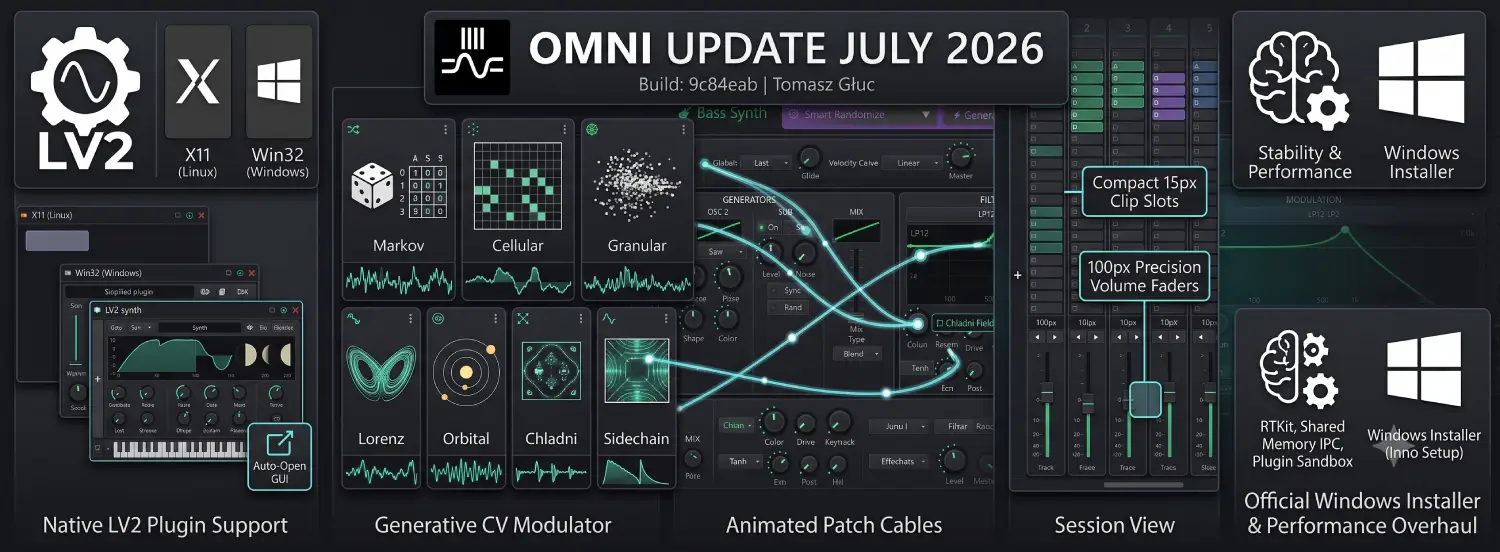
🔌 Native LV2 Plugin Support & Platform GUI Hosting
Omni expands its plugin compatibility matrix with full native support for LV2 (LADSPA Version 2) — the open, extensible audio plugin standard widely used in Linux and open-source audio production:
- Native System Bindings &
liblilvIntegration — custom high-performance Rust bindings (omni_lv2_sysandomni_lilv_sys) enable instant plugin discovery, low-latency DSP processing, and complete state persistence for LV2 synths and effects without external bridging overhead. - Platform-Native GUI Hosting (X11 & Win32) — full support for native plugin editor windows on both Linux (
X11UI) and Windows (WindowsUI/Win32), allowing plugins built with frameworks such as DPF or Pugl (e.g., Dragonfly Reverbs) to render their full custom interfaces seamlessly. - Auto-Open Plugin GUI — upon inserting any plugin (CLAP, VST3, or LV2), Omni automatically opens its editor GUI for immediate parameter tweaking and faster sound design workflows.
- Sample Rate Sync & Compatibility Fixes — synchronized DPF/Pugl sample rate initialization (dynamically supporting 44.1 kHz, 48 kHz, and higher host sample rates) and resolved MSVC build compatibility for
ZIX_STATIC_STRING.
🎛️ 8 Generative & Algorithmic CV Modulators
We have added 8 new CV modulators to Omni's modulation engine, turning the DAW into a deeply expressive, generative modulation playground:
- 🎲 Markov — a stochastic step generator using Markov chain transition probability matrices to generate continuously evolving rhythmic and melodic CV patterns.
- 🧬 Cellular — cellular automata modulation based on Conway's Game of Life, translating two-dimensional cell evolution into organic control voltages.
- 🌾 Granular — applies granular processing principles to control signals, chopping and density-blending CV streams into textured modulation clouds.
- 🌊 Tidal — models gravitational tidal forces and ocean wave cycles for long-period, breathing rhythmic undulations.
- 🌀 Lorenz — a 3D chaotic Lorenz strange attractor system outputting smooth, non-repeating 3D trajectories for complex spatial and filter modulations.
- 🪐 Orbital — gravitational N-body physics simulation where orbiting masses exert gravitational pull on parameter values (with tuned energy dampening to prevent chaotic orbit explosions).
- 🔔 Chladni — simulates 2D acoustic nodal plate vibration patterns (Chladni figures), mapping acoustic modal resonance to multi-destination modulations.
- 🔊 Sidechain — a dynamic real-time audio envelope follower that extracts amplitude envelopes from any track to modulate parameters anywhere across the session.
- Visualizer & Binding Polish — live card previews now maintain continuous real-time rendering, and duplicate modulator assignments on the same parameter are automatically prevented.
🎙️ Session-to-Arrangement Progression Recording & Live Aliasing
We resolved a critical workflow issue when recording multi-clip progression performances from Session View into the Arrangement timeline:
- Session-to-Arrangement Progression Fix — previously, recording MIDI clips from Session View inherited the track's default loop length at recording start, causing the arrangement renderer to loop only the first bar repeatedly (resulting in a single repeated chord instead of the full recorded chord progression). The recorder now dynamically captures per-clip
loop_len_beats— identical iterations fold cleanly into loop aliases, while variations (due to probability or humanization) automatically flatten into continuous one-shot progressions. - Live Arrangement Aliasing — Arrangement clips linked to Session clips now act as live aliases, reading notes directly from the source clip so any edit made in the Piano Roll is immediately reflected in the Arrangement timeline in real time.
- Seamless Piano Roll Access — double-clicking a MIDI clip in the Arrangement view now opens the corresponding Session clip Piano Roll editor directly (instead of adding a warp marker), and clip thumbnails in the Arrangement render live note patterns.
🧵 Animated Patch Cables — Interactive Modulation Drag & Drop
Connecting modulators to parameters is now a tactile, visual experience with real-time feedback:
- Dynamic Animated Cables — when dragging a modulator output onto any target parameter in the interface (knobs, faders, numerical fields), Omni renders a glowing, animated patch cable connecting source and destination in real time.
- Clear Routing Feedback — provides instant visual verification of modulation assignments, bringing the intuitive feel of modular hardware patchbays directly into software production.
⚡ Plugin Sandbox Overhaul & Engine Hardening
We conducted a thorough stability, performance, and real-time safety audit across Omni's process-isolated plugin sandbox and host architecture:
- RTKit & Real-Time Priority Tuning — adjusted RTKit CPU budget allocations (
RTTimeUSecMax) on Linux to prevent CPU time limit kills (SIGXCPU) when loading heavy plugins under high loads. - Sequential Shared Memory Handshake — replaced reset-flag signaling with sequential block numbering in shared-memory IPC, completely eliminating double-processing race conditions and audio stutter at low latency.
- Sidecar GUI Resilience — heavy plugin initializations no longer cause watchdog process teardowns; latency spikes are handled gracefully while keeping native plugin editor windows active.
- Windows VST3 Entry Point Fix — corrected VST3 DLL entry point initialization on Windows to call
InitDll/ExitDll, fixing crashes when loading VST3 plugins (such as Dragonfly Plate Reverb). - Memory & DSP Optimization — integrated
mimallocas the global allocator in host processes for lower memory allocation overhead, and upgraded spectrum analysis torealfftfor 2x faster real-time FFT rendering.
🎚️ Session View Redesign & Interface Refinements
- Compact 15px Clip Slots — redesigned Session View mixer tracks with compact 15px slots, maximizing clip overview density for live performance and complex arrangements.
- 100px Precision Volume Faders — extended volume faders for higher-resolution mix adjustments and fine gain staging.
- Maximized Startup Guarantee — enforced startup window maximization with Win32 fallback logic on Windows systems.
- Interaction Polish — refined drag physics for faders and knobs across session views, and updated device chain navigation.
📦 Official Windows Installer (Inno Setup)
- Added an official Windows installer target built with Inno Setup, supporting single-click executable setup, Start Menu integration, desktop shortcuts, and automatic
.omniproject file associations.
Over the past week, Omni has expanded into new plugin ecosystems with native LV2 support, introduced powerful generative modulation capabilities, fixed progression recording from Session to Arrangement, and significantly hardened session stability. We look forward to seeing how these new tools inspire your creative workflow! 🚀