Build: f4fcee3 | June 24 – July 13, 2026
👁️ Iris — Spectral Synthesizer Powered by Gemini AI
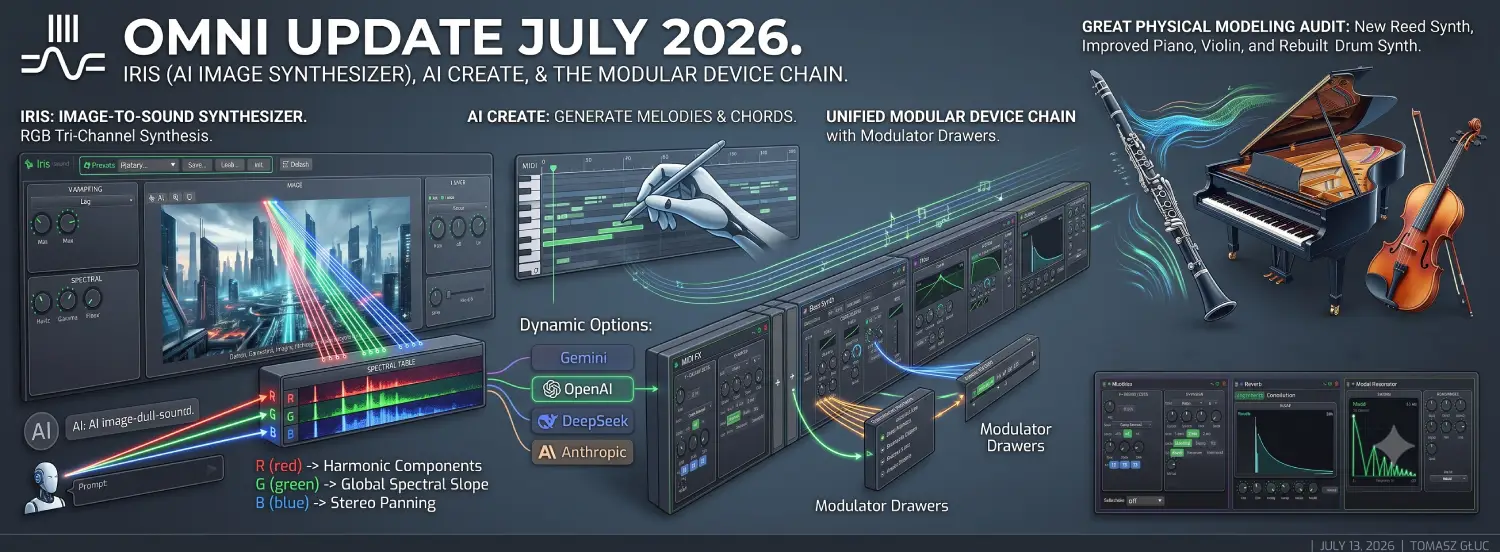
The latest flagship instrument built into Omni is Iris — an image-to-sound synthesizer with deep AI integration. Although the concept of image sonification as a spectrogram (X-axis is time, Y-axis is frequency, and brightness is volume) has a rich history, Iris brings entirely new, proprietary solutions to this paradigm:
- RGB Tri-Channel Synthesis — unlike traditional spectral synthesizers that reduce the image to grayscale, Iris analyzes three color channels separately:
- R (red) controls the amplitude of individual harmonic components (partials).
- G (green) determines the global spectral slope (tilt) in a given time frame.
- B (blue) controls panning and stereo width for each component independently.
- Harmonic Snap — raw sonification often leads to atonal noise. In Iris, you can enable Y-axis quantization to a selected musical scale (from a library of 24 predefined scales). This ensures that AI-generated images sound harmonious and clean in the context of your track.
- Dual Scan Heads — two independent read heads (Scan Heads) can scan the same spectral table at different speeds, offsets, and directions (Linear, Ping-Pong, Spiral), creating incredibly evolving, phasing spatial textures.
- MIDI Playability and Additive Synthesis — Iris is a fully polyphonic instrument. MIDI notes transpose the base spectral table, and parameters are read and synthesized in real time, optimized for audio thread safety.
- AI Image Generation — the built-in module uses the
gemini-2.5-flashmodel. Just enter a prompt (e.g., "futuristic city in the rain, neon night") to get a ready-to-use, unique sound texture in seconds.
🤖 AI Create — Generate Melodies and Chords Directly in the DAW
We have expanded our artificial intelligence features with two powerful MIDI generators accessible directly from the timeline:
- Melody Generator — generates melodic lines based on specified parameters, tempo, and the selected scale. The tool supports dynamic selection of leading AI models (Gemini, OpenAI, DeepSeek, Anthropic).
- Chord Progression Generator — allows you to instantly create inspiring chord progressions. Thanks to the updated AI client, the generated harmonic structures are sent directly to the MIDI clip as sample-accurate notes.
⛓️ Device Chain — Modular Device Chain
We have redesigned the way instruments and effects are organized on tracks, introducing an integrated, horizontal Device Chain inspired by best practices:
- MIDI FX, Synth, and Audio FX Unification — all plugins (both internal and external CLAP/VST3) are located in a single, clear signal flow chain.
- Modulator Drawers — each module in the chain has a dedicated, pull-out section for assigned modulators (LFOs, envelopes, etc.), which drastically simplifies navigation and modulation management.
- Stability and Persistence — we have improved the handling of external plugins (no crashes during rapid instrument switching) and ensured full persistence of chains on Master and Return buses.
🔄 Modulation — Full Routing Freedom
The Omni modulation system has gained new, advanced features:
- Drag and Drop — you can now drag and drop modulators to any parameter directly from the context menu.
- Cross-Modulator Modulation (Phase B) — a modulator can now modulate the parameters of another modulator. You can control the frequency of one LFO using an ADSR envelope or another LFO, allowing for the generation of complex, unique waveforms.
- MIDI FX Modulation (Phase C) — parameters of MIDI FX plugins (such as an arpeggiator or scale quantizer) can now be fully modulated.
- Right-Click "Add Modulation" — quickly assign modulators to any parameter directly from the context menu.
🎻 Great Physical Modeling Audit and Rebuild
We performed a detailed quality and performance audit of our built-in instruments, eliminating shortcomings and bringing physical modeling to the highest level:
- Reed Synth — rewritten completely from scratch. The new physical model of the clarinet and saxophone faithfully simulates the dynamics of reed vibration and airflow within the instrument's body.
- Violin — we added advanced bow friction modeling (STK), rosin noise adjustment, precise microtuning (±10 cents), and a three-dimensional, modal stereo soundbox.
- Piano — a thorough rebuild of the engine. We introduced full simulation of sympathetic string resonance, damper pedal, hammer strike noise (hammer contact), and a dedicated output filter.
- Alchemy & Bass Synth — we conducted an audio thread safety (RT-safety) audit. We added de-clicking (crackling elimination) for all smooth parameter transitions and blends, and a dedicated "Bass Mono" mode that stabilizes the lowest frequencies in the Bass Synth.
🎨 Visual Unification of Solaris and 3D Sections
The entire Omni graphical user interface is moving towards a consistent, premium design:
- Solaris Widgets Everywhere — we unified the look of all built-in effects and modulator sections.
- 3D-styled UI Plates — in Bass Synth and other modules, we introduced three-dimensional panels with gradients and subtle drop shadows, giving the interface depth and a modern character.
Over the past three weeks, we have focused on making Omni sound more powerful, look more modern, and offer unprecedented creative tools. The combination of advanced physical modeling with the generative AI of Gemini makes Omni a complete environment for the music production of tomorrow. 🚀
How do you like the Iris synthesizer and generating parts via AI Create? We look forward to your feedback!